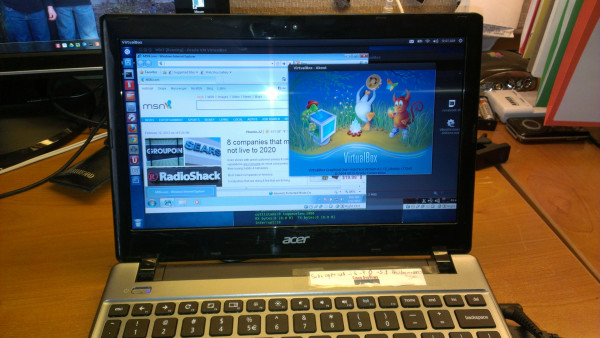
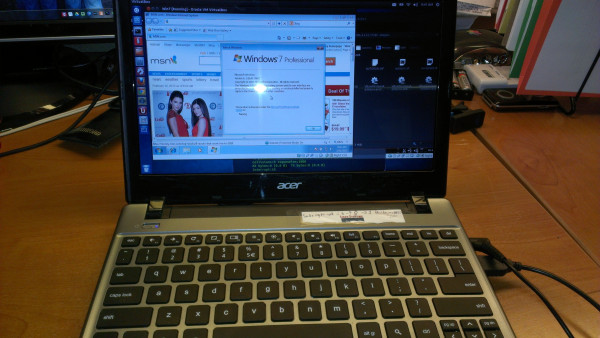
Acer C7 Mostly Working Virtual Box 4.1.12 in Chrubuntu 12.04

Trying to get Virtual Box 4.1.12 from the software center is not a basic download and run.  You can download it, you can run it but when you try to start a machine you create it crashes… always.

*PLEASE NOTE* This instruction set is for educational purposes only.  If you follow these instructions and something bad happens to your computer you will need to contact your support staff / warranty center for support.  There is no written guarantee or warranty implied or inferred with this instruction set.  Use at your own risk.

If you too are having this issue I found someone who posted a way to make VirtualBox  mostly work in Chrubuntu for the Acer C7.

Steps –

  1. Install Chrubuntu on Acer C7 if you haven\’t already.
  2. From a shell in chrubuntu run

wget http://www.cisgendered.com/~keyvin/virtualbox-kernel-mods-3.4.0.deb

sudo dpkg -i virtualbox-kernel-mods-3.4.0.deb

Thank you to – Keyvin and his website http://www.cisgendered.com/?p=24 for his work.

Chromebook C-7 Running Ubuntu 12.04

I finally got my hands on a Chromebook in November of 2012.  I enjoyed the idea of a quick simple PC and wanted to get one for myself so I did.  I purchased an Acer C7 Chromebook.  But not just to run ChromeOS, I wanted it to be a multi-boot machine so I could do various things in different OS’s on a very nice and slim platform for portability.

I was able to find enough information to make this work, now I want to share with anyone else that might want to get this working on their Acer C7 as well.

First things first – Many people put a lot of time and effort into making this work so all credit and accolades are due to them.  Secondly *PLEASE NOTE* This instruction set is for educational purposes only.  If you follow these instructions and something bad happens to your computer you will need to contact your support staff / warranty center for support.  There is no written guarantee or warranty implied or inferred with this instruction set.  Use at your own risk.

This write up is for an Acer C7 only – Not sure if it will work with other models.

The creator of Chrubuntu has a great step by step setup on how to install Chrubuntu on your Acer C7. *A word of caution* Create a backup USB or SD card so you can revert back if you need to.  Minimum 4GB SD / USB card required  I had to use it twice and it made for a quick restore and start over. Full Recovery info and quick info is boot in to ChromeOS – open chrome://imageburner in your browser and follow the steps. You can download the windows image creator or mac image creator if needed as well so they have multiple ways to get you back to square one.

After you create the backup usb you need to enable Developer Mode on the Acer C7.

To enable developer mode you need to do the following –

  1. Backup any files you have on the C7 locally on the drive.
  2. Power down Acer C7.
  3. Push the esc +F3 (refresh key).  While holding those buttons push the Power button to turn the C7 on.
  4. A screen shows up a Chrome OS is missing or damaged (this is what you want).
  5. Press ctrl+d to boot into developer mode.
  6. The screen will say press ENTER to turn OS verification off.
  7. Press Enter.
  8. It will reboot the machine.
  9. At this point until you change it your Chromebook will always boot into OS Verification is off screen.
  10. You can either wait 30 seconds (it will beep twice at you ) then boot or you can push ctrl+d to immediately boot.
  11. The first time you run into Developer Mode it will actually transition your system to Developer Mode – *This will delete your local files if you have any on the chromebook*
  12. Now you are in Developer mode the instructions from Jay Lee will now work.

Once your Acer C7 is in developer mode you now need to go Here for how to install Chrubuntu.  JayLee has a donate button so throw him some money if you actually use the code to help pay for random stuff.

Once you have chrubuntu installed and are inside Chrubuntu you can set it up to always boot into Chrubuntu or vise versa.

To boot into ChromeOS from Chrubuntu.

  • In Chrubuntu type sudo cgpt add -i 6 -P 0 -S 1 /dev/sda (That is a ZERO after P) to boot into Chrome OS in a terminal window
  • password for sudo is user if you did not create one via passwd method.
  • reboot into Chrome OS

To get into Chrubuntu from Chrome –

  • Before you log on to Chrome push ctrl+alt+f2 to get into developer console
  • Login – chronos
  • type in  sudo cgpt add -i 6 -P 5 -S 1 /dev/sda This will boot into Chrubuntu always until you change it.
  • type exit.
  • ctrl+alt+f1 (go back to login screen for chromeos)
  • Power down.
  • Power back up and it should boot into Chrubuntu.

A very good video going to developer mode, to installing Chrubuntu on an Acer C7 is on youtube Here  Just do this for the wget command instead – wget http://goo.gl/tnyga; sudo bash tnyga

Fun with Virtualbox and Error with 64bit Hardware Acceleration on Lenovo T420

So I was having some fun installing Virtual box on my Backtrack 5 R3 install on a new SSD that I am running for a laptop of mine and found an interesting error.

error: “VT-x/AMD-V hardware acceleration has been enabled, but is not operational. Your 64-bit guest will fail to detect a 64-bit CPU and will not be able to boot. Please ensure that you have enabled VT-x/AMD-V properly in the BIOS of your host computer.”

So this error is simply telling me to enable hardware acceleration in my Bios.  For me I am running this on a IBM Thinkpad Lenovo T420 so I went in and changed the setting.

*PLEASE NOTE* This instruction set is for educational purposes only.  If you follow these instructions and something bad happens to your computer you will need to contact your support staff / warranty center for support.  There is no written guarantee or warranty implied or inferred with this instruction set.  Use at your own risk.

To fix this, I did the following:

  • Restarted IBM T420 laptop.
  • Pushed Blue Thinkvantage button when told to do so.
  • Pushed F1 for Bios.
  • Right arrow over to Security Tab
  • Down arrow to Virtualization and pushed the enter key
  • Hit enter on the Intel Virtualization Technology – A Blue Box will appear
  • Down arrow to Enabled, hit Enter. (Enabled should be highlighted in white.)
  • Down Arrow to Intel VT-d Feature and hit enter.
  • a Blue box will appear and down arrow to Enabled (Enabled should highlight white) and hit enter.
  • Push F10 to save and exit.

When I rebooted into Backtrack and ran Virtualbox I was able to install my 64Bit Win7 machine as well as other 64bit OS’s 

Getting Virtualbox running on Backtrack 5 R3 Gnome

For fun (and obvious reasons, to take snapshots), I wanted to run VirtualBox on my Backtrack 5 R3 64-bit GNOME setup.  I did the standard looking for it by doing: sudo apt-get update; sudo apt-get install virtualbox-4.0, and getting an error was kind of what I thought I would get.

Google being my friend (or Bing if you like that) I came across a post and quick video –

http://netsecuritystuff.wordpress.com/2011/05/23/virtualbox-on-backtrack-5/

and a video here –

http://www.youtube.com/watch?v=en7O-LLrmxc

Both essentially tell you to do the same thing (one with just the CLI from the webpage, and the other via navigation in the video and the Command Line Interface).  So whichever method you prefer; CLI worked for me.

*PLEASE NOTE* This instruction set is for educational purposes only.  If you follow these instructions and something goes wrong with your computer, you will need to contact your support staff/warranty center for assistance.  There is no written guarantee or warranty implied or inferred with this instruction set.  Use at your own risk.

The netsecurity link advises updating kernel headers

# prepare-kernel-sources

# cd /usr/src/linux

# cp -rf include/generated/*include/linux                  *Note this step did not work for me*

Then edit your /etc/apt/sources.list file to include the debian luicid non-free list

Via Command line –

#  echo deb http://download.virtualbox.org/virtualbox/debian lucid contrib non-free >> /etc/apt/sources.list

or navigate via the folders and edit the file directly and paste –  deb http://download.virtualbox.org/virtualbox/debian lucid contrib non-free

# wget -q http://download.virtualbox.org/virtualbox/debian/oracle_vbox.asc -O- | sudo apt-key add –

Do an update

#apt-get update

Search for virtualbox within your repository

#apt-cache search virtualbox      *this was handy to see if what I was doing was working right*

#apt-get install virtualbox-4.0

*Note* once I installed 4.0 it said there was a new version available and well just wanting to run / test it out seems to work fine.  I am running Virtualbox 4.0 on my Backtrack 5 R3 Gnome version with 64bit without an issue.  However I could have installed the newer version of virtualbox-4.2 just to be more up to date.. but I didnt want to 

100% of the credit goes out to the author at –

http://netsecuritystuff.wordpress.com/2011/05/23/virtualbox-on-backtrack-5/

and the video is nice if you want to see what you should do but I was able to do the instructions via the command line with no issues.

Enjoy

and as Armitage says – Happy hunting!

Magic Box IP Subnetting

So, during a random discussion whilst I played Call of Duty: Black Ops, it was about IP subnetting and the CCNA test.  So IP subnetting, basic base-2 math, is actually very simple to accomplish.  The tough part is trying to QUICKLY attain this information while testing.

I was taken aback when I was asked how I did this during my 3 CCNA testing methods, and Mike Storm, an instructor at Interface Technical Training in AZ, had an awesome method called the Magic Box.  His upbeat training and encouragement were able to take something like IP Subnet Masks and break it down for testing purposes, so that when you get a question about how many hosts you have, you can fairly quickly know which subnet you need to work with.

This post assumes you have a basic understanding of IP Subnetting and how it works.  The understanding of what Classless Inter-Domain Routing (CIDR) notation is, what subnet masks are, and the magical line that delineates hosts from networks.  With a basic understanding, this magic box (when tested) makes it easier to grasp what is being asked in a concise format.  *In most tests, you have about 1 minute, or less, per question, and when you stay on one for 5-10 minutes just trying to decipher some of it, it will throw you for a loop.

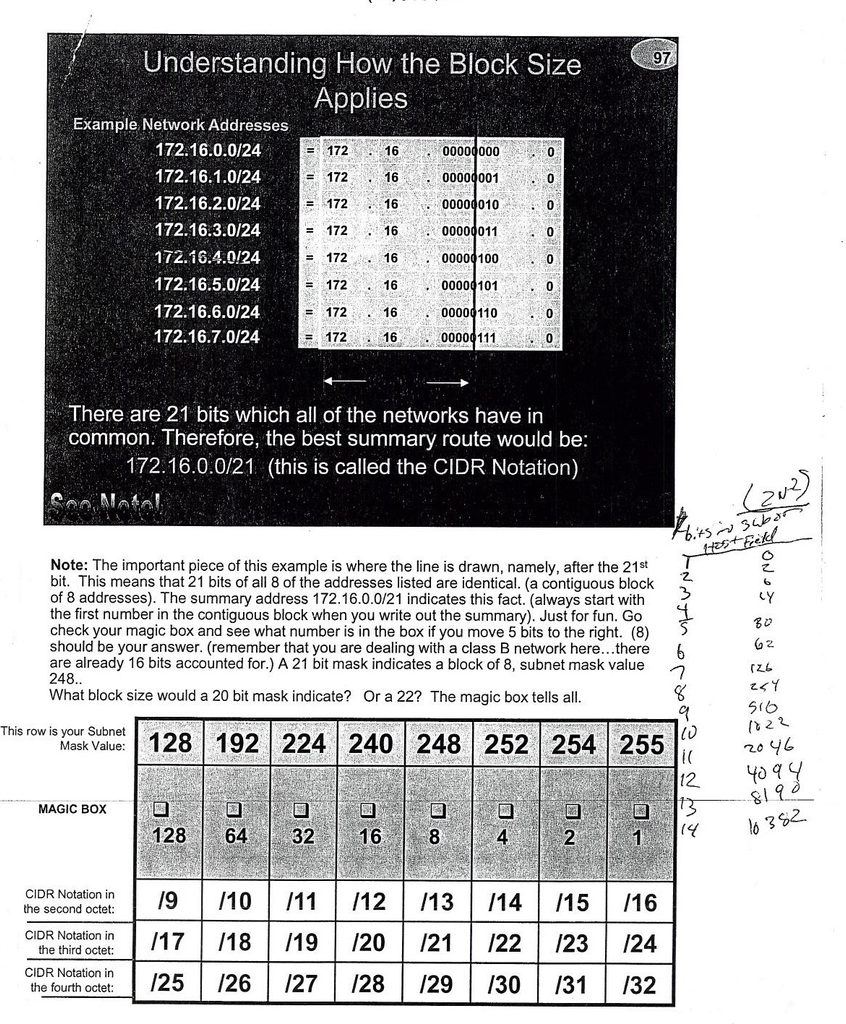
Enough of that mumbo jumbo; let’s get to the good stuff.  Here is what Mike Storm taught me with the magic box –

So simple explanation is you essentially just need to KNOW the top row.  From the top row you can fill in the rest easily.

  • Notice that the top row corresponds with the various subnet masks most commonly utilized.
    • 128,192,224,240,248,252,254, or 255.  The ”octet” determines the CIDR notation.  Meaning, if it is in the Second Octet, it will be a /9 /10 /11 /12 /13 /14 /15 /16, respectively.
      • Small side note – These ”slash numbers” e.g., slash 16, equal the number of bits in the subnet mask in use between the network, Subnet, and host.  /16 would be – X= number, n= network, and h = host xnnnnnnn.xnnnnnnn.hhhhhhhh.hhhhhhhh in binary.  If you are in a Class B subnet, the first two octets are the only ones of concern for network addressing.
    • The CIDR notation can then be deciphered, say if you get asked if Network B has a /25 network yet needs 700 hosts what network would support the required number of hosts… quickly (if you wrote this down) you can answer the question.  If you aren’t using a quick method, you are figuring it out from scratch, unless you are quick with binary to convert back to decimal to determine which networks and hosts can support such a network.
    • With that same question – /25 network and 700 hosts doesnt work.  Why? Because you look at what /25 is and look up in the column to see that the network is split into two 128-segment networks, which cannot handle 700 hosts.  Most people should realize that a /24 is a 256-node network (0 through 255 = 256), and that after removing the broadcast and network addresses, the total usable nodes are 254.
      • ***NOTE the equation 2N-2 to determine actual host count… this removes the broadcast and network addresses from ”usable” range which in turn gives you the actual numbers available.***

There are a ton of articles about how to subnet/put things down / figure things out, but this magic box (when testing) makes it very simple to quickly remember all the variations.  I’ve used it 2 times in the 3 times I have passed my CCNA combined test (one test to get the CCNA), and it helped me save time on a few questions.

Hope you like this, and happy subnetting!!

Cool new program for M$ PC Mouse sharing / File copy

So I read an article about a new project called Mouse without Borders on LifeHacker. I’ve been using Synergy for years, and at home I mainly have a multi-OS setup, so it works great for switching between computers there. At work, we are pretty much a Windows shop, so having this mouse sharing WITH clipboard makes life easier.

Just installed, so not sure how well it will work for me (interaction with programs and whatnot), but I was able to set up and test the clipboard. Single-file copy only (zip multiple files if you need to do it at once) for clipboard, and for some odd reason the security key required me to click a back arrow, and it showed up?? Who knows why, but it seems like a good program.

Link to Lifehacker\’s article 

Mouse without Borders Video

Mouse without borders direct download

If you have multiple OS\’ and you only want to use a single keyboard – Synergy is the way to go. I love that program 

Mouse sharing Multiple computer keyboard mouse sharing Synergy Mouse alternative

Fun times with 1993 300zx

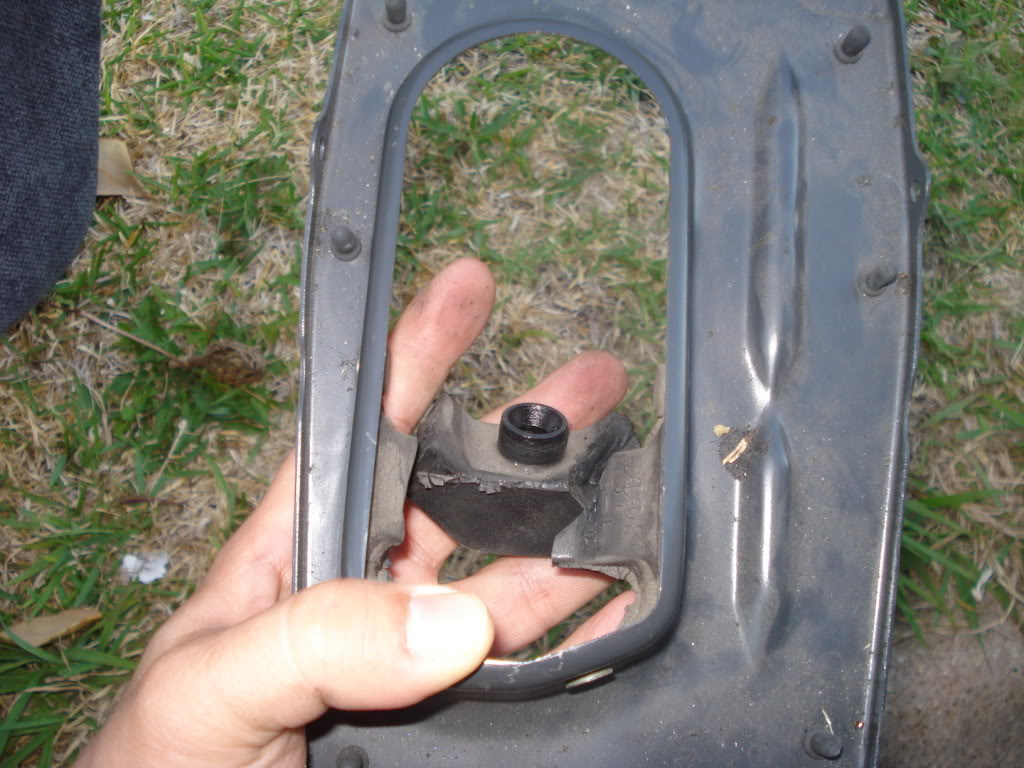
So I was driving when the shifter in my 1993 300ZX got VERY wobbly/loose, and I was quite confused. Apparently, there is a part on a 1993 300ZX manual transmission that fails often. The Shifter Support Bracket for the 1993 300zx just straight up busted on me…

Now the shifter would go into gear, and while in gear, it seemed fine. When you pulled it out, it would rattle a bit because the shifter would go down and hit the drive shaft, which was a bit odd to me. No pictures just yet, but here is some info from someone else that had the same problem.

After initial research, I thought it was what this guy thought it was (the bushings), but after tearing apart the front dash of my 1993 Nissan 300ZX, I soon found out it wasn’t.


Funny anecdote – I like to drive this car, so I used some JB Weld to see if it would hold it in place until I could pick up a part. It worked for the past 3 days

I found the part locally – Link @ Website Pit Stop Performance in Phx, so hopefully you can get this part at a local vendor; if not, these guys are good and can ship it to you. I called my local dealer and the guy said it was $170….. um.. I will take $ 40 vs. $170 any day!

Nissan OEM Shifter Mount Support Bracket – Nissan 300ZX Z32
https://conceptzperformance.com/nissan-infiniti-nissan-oem-shifter-mount-support-bracket-nissan-300zx-z32-34560-30p00_p_1877.php?quantity=1

Hope this may help someone searching Google for a similar problem with their car.

Busted Capacitors

Random IT stuff

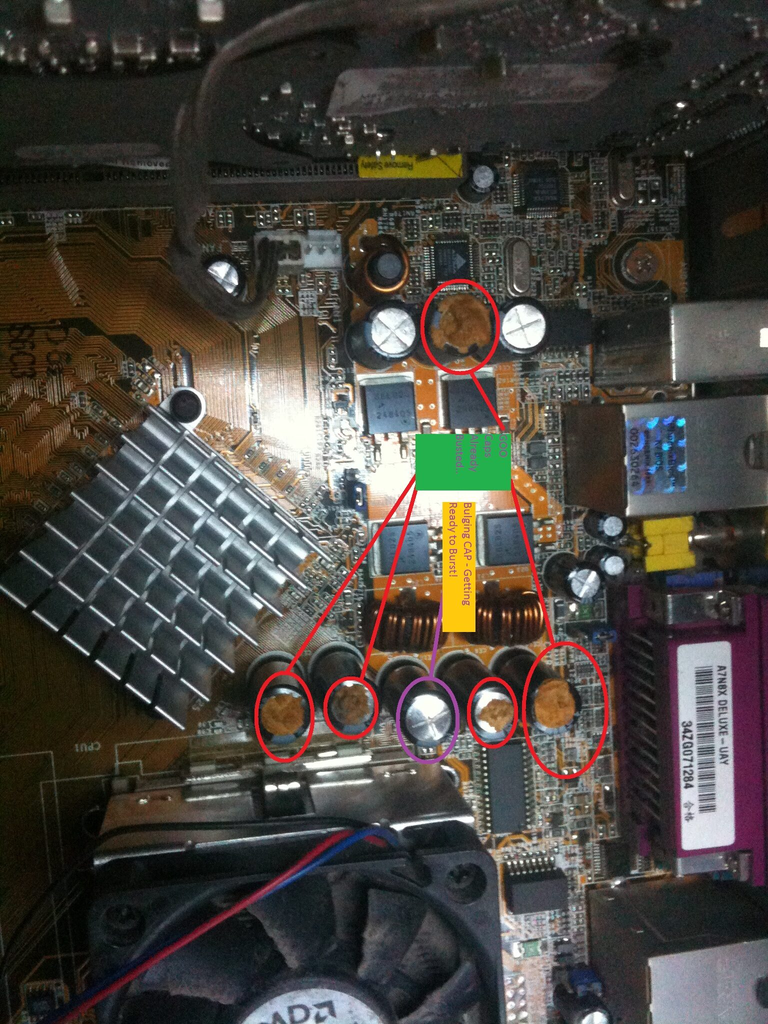
So I was asked by a co-worker to take a look at his PC and why it was randomly not booting / sometimes not getting to the BIOS, and I told him it is most likely hardware-related.  He was hoping his drive was OK for getting files off it, but my suspicion was right.  Unfortunately for him, he most likely does not want to drop 70-80 bucks to get the same mobo, etc so either parts or a donated PC for him.  And a quick USB drive connection will copy his files.

FYI for anyone looking for a capacitor on a motherboard that is fried/busted / not quite right… Here is a picture for your enjoyment.